
Table of Contents
- Why Radiant Heating Suits Large Warehouses
- Radiant Heating vs Warm Air Heating
- Types of Warehouse Heating Systems Compared
- Planning Warehouse Heating Zones
- Warehouse Heater Installation: What to Expect
- Costs, Payback and Choosing the Right System
- Frequently Asked Questions
Last Updated: October 16, 2026
Why Radiant Heating Suits Large Warehouses
Radiant heating for large warehouses works by warming people and surfaces directly rather than the air around them, which is why it outperforms convection systems in tall, open buildings. At Flexel, we have manufactured electric radiant systems since 1978, and the same principle that makes them effective in a workshop applies at warehouse scale: heat travels in straight lines until it meets something solid, and that something is your team, your racking and your floor.
Most warehouse heating strategies fail for a straightforward reason. Warm air rises. In a building with an 8-metre ridge height, a convection heater spends its entire working life warming the roof void while the pickers below stay cold. The Chartered Institution of Building Services Engineers guidance on building services has long recognised that stratification is the dominant heat loss mechanism in high-bay spaces, and no amount of extra boiler capacity fixes it.
The Problem With Heating Dead Space
Dead space is the volume between the working zone and the roof. In a typical distribution centre it accounts for the majority of the building’s air volume, and convection heating warms all of it before the floor feels anything.
Radiant systems sidestep this entirely. Because energy is emitted as infrared, it does not need air as a carrier, so there is nothing to stratify. You heat the bottom three metres, where people actually work.
The single biggest efficiency gain in a large warehouse is not a better boiler. It is switching from heating air to heating surfaces, which removes stratification loss at the source.
Radiant Heating vs Warm Air Heating
Radiant heating is more efficient than warm air heating in large warehouses because it targets occupied zones directly instead of conditioning the entire building volume. The trade-off is that radiant systems suit spot and zone heating better than uniform whole-building climate control.
The practical differences come down to four things:
- Response time. Radiant panels reach working temperature in minutes. Warm air systems must heat the building fabric first, which can take hours on a cold Monday morning.
- Door openings. Every time a loading bay door opens, warm air escapes. Radiant heat is unaffected because it is not stored in the air.
- Air movement. Convection systems circulate dust, which matters in food, pharmaceutical and clean manufacturing environments.
- Zoning. Radiant emitters are individually controlled, so a half-empty warehouse only costs you for the half in use.
Where warm air still wins is in buildings that need genuinely uniform temperature throughout, such as certain process environments. For a picking and storage operation, radiant is almost always the better fit.
Types of Warehouse Heating Systems Compared
Three radiant technologies dominate large warehouse installations, and the right choice depends on ceiling height, power availability and whether the floor is being replaced.
Electric Infrared Panels
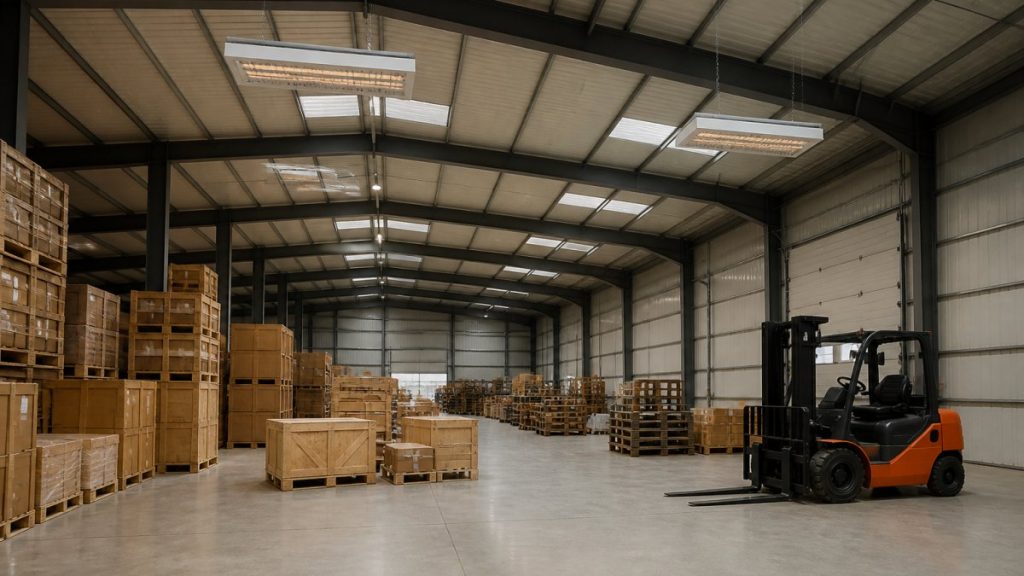
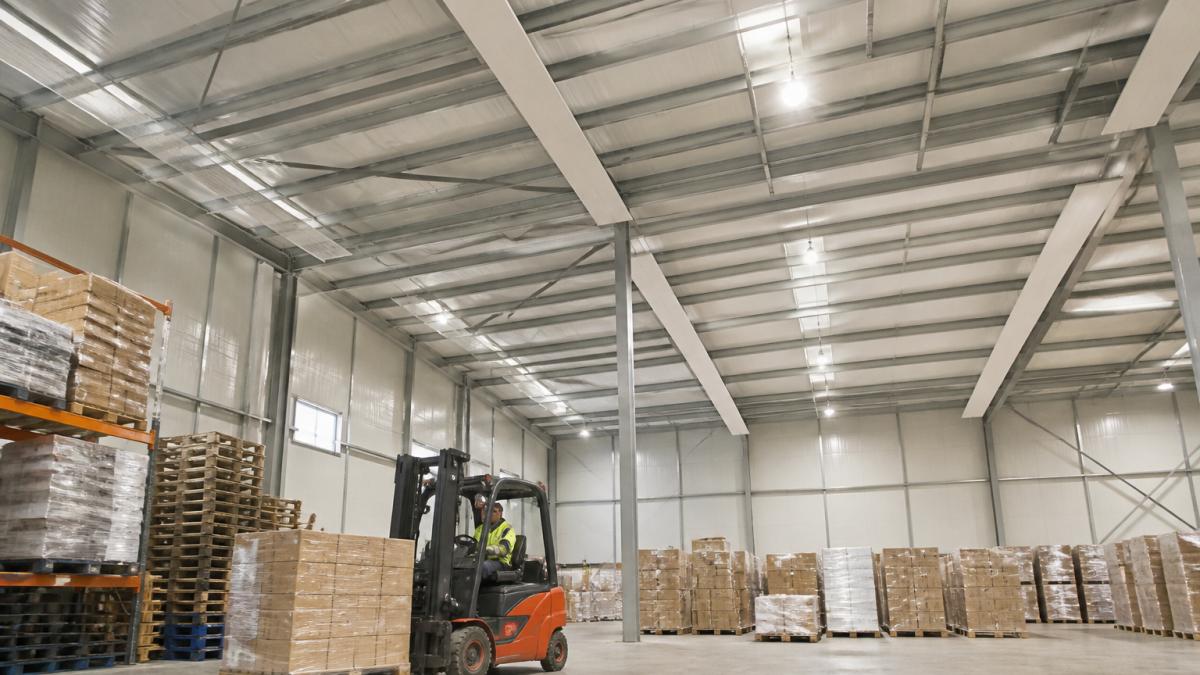
Electric infrared panels are flat emitters mounted at height that radiate heat downward onto the working zone. They are the simplest to install because they need only a power supply, no flue and no gas connection.
Installation is fast: a competent electrician can mount and commission a panel in a fraction of the time a gas system demands. Running costs depend on your electricity tariff and how well you zone the system, and the panels suit warehouses where gas is unavailable or where the roof structure cannot take the weight of a tube heater.
Mount infrared panels so the beam pattern covers the aisle, not the racking top. A common mistake is aiming for even ceiling coverage, which wastes output on the void above the goods.
Gas-Fired Radiant Tube Heaters
Gas-fired radiant tube heaters burn gas inside a steel tube, which glows and radiates heat along its length. They deliver high output per unit and suit very large, open spaces where a gas supply already exists.
The drawbacks are real. They need flueing, gas safety certification and periodic servicing, and they cannot be zoned as finely as electric panels. In a building with intermittent occupancy, the standing losses and minimum run times can erode the efficiency advantage.
Underfloor Radiant Heating
Underfloor radiant heating embeds heating elements in the floor slab, turning the entire floor into a low-temperature emitter. It is the most comfortable option and the most disruptive to install, because the floor must be excavated or overlaid.
For warehouses, underfloor heating is usually only viable during a new build or a major refurbishment. Where it is an option, it pairs well with electric infrared panels at high level: the floor provides background warmth, and the panels handle rapid response in occupied zones.
| System | Best For | Installation Disruption | Zoning Control |
|---|---|---|---|
| Electric infrared panels | Retrofit, spot and zone heating | Low | Per panel |
| Gas radiant tubes | Large open spaces with gas supply | Medium | Per circuit |
| Underfloor radiant | New builds and major refits | High | Per zone |
Planning Warehouse Heating Zones
Warehouse heating zones are the single biggest lever on running cost, because a well-zoned system only heats the areas in use. A poorly zoned one heats the whole building to serve one shift.
Start by mapping how the building is actually used rather than how it is drawn on the plan. Most warehouses have at least three distinct patterns:
- Permanent occupancy: picking aisles, packing benches, offices and control rooms.
- Intermittent occupancy: loading bays, goods-in and dispatch, where doors open constantly.
- Unoccupied: bulk storage racking, mezzanine undersides and plant rooms.
Match the emitter to the pattern. Permanent zones suit continuous low-level radiant output. Intermittent zones need fast-response panels that can be switched on for a shift and off again. Unoccupied storage rarely needs heating at all beyond frost protection, which is where a low-temperature radiant system earns its keep by preventing ice build-up and frozen pipework without conditioning the whole volume.
Zoning a warehouse on paper without checking the actual shift pattern is the most common and most expensive mistake. A system that is technically well-designed but switched as one block will consume as much as an unzoned one.
Warehouse Heater Installation: What to Expect
Warehouse heater installation for electric radiant systems typically involves a site survey, a mounting plan, power provision and commissioning, with most of the disruption confined to the electrical connection rather than the building fabric.
The sequence usually runs like this:
- Survey and heat load assessment. Confirm ceiling height, insulation levels, door locations and existing power capacity.
- Mounting plan. Position emitters to cover occupied zones, accounting for racking heights that could block the beam.
- Power provision. Run supplies to each zone, ideally on separate circuits so zoning works properly.
- Mounting and commissioning. Fix brackets, mount panels, connect and test.
- Control setup. Configure zone controllers and time schedules to match shift patterns.
The genuine advantage of electric radiant over hydronic systems is that there is no pipework, no boiler and no water treatment. An electrician can complete the work without a heating engineer, and there is no risk of leaks above stock. Our systems are approved to international standards including EN 60335-2-96 and IEC 60800, which matters when a facilities team needs documentation for an insurer or a building control sign-off.
Costs, Payback and Choosing the Right System
Capital cost and running cost pull in opposite directions, and the right answer depends on how many hours a week the building is actually occupied.
As a rule of thumb, systems that are cheap to install tend to cost more to run, and systems with the lowest running cost demand the most disruptive installation. Electric infrared panels sit in the middle: modest capital outlay, no gas infrastructure, and running costs that fall sharply once zoning is done properly.
When comparing quotes, ask for these figures rather than a headline price:
- Installed cost per zone, not per building, so you can phase the work.
- Design heat load in watts per square metre for the occupied area only.
- Assumed occupancy hours per week, which drives the running cost estimate.
- Control specification, because zoning is where the savings live.
Payback on a well-zoned radiant system comes from two places: the reduction in heated volume and the ability to switch off unoccupied zones entirely. A warehouse that currently heats 100% of its volume for 40% occupancy has an obvious gap to close.
Warehouses with high ceilings, intermittent occupancy and no existing gas supply, where fast-response electric radiant panels avoid both the flueing cost and the stratification losses of warm air.
For a 50,000 sq ft facility, the sensible approach is usually a phased rollout: start with the highest-occupancy zones, measure the running cost for a quarter, then extend. That gives you real data rather than a supplier’s estimate.
Heating a large warehouse efficiently comes down to one decision: stop heating air and start heating people. Flexel has spent over 45 years manufacturing electric radiant heating systems in the UK, and our infrared panels and underfloor systems are designed for exactly this problem, with fast response, fine-grained zoning and no gas infrastructure to maintain. As part of the Fenix Group, we build to international standards including EN 60335-2-96 and IEC 60800. Get started with Flexel and turn your warehouse’s dead space into a line item you no longer pay for.
Frequently Asked Questions
How does radiant heating work in a large warehouse?
Radiant heating warms people and objects directly rather than heating the air. In a warehouse, infrared panels or radiant tubes emit heat that travels in straight lines until it hits a surface, such as a person, floor or racking. This means you feel warmth within minutes without waiting for the entire air volume to heat up. For large warehouses with high ceilings, this approach avoids the energy waste of warming air that rises and escapes.
Is radiant heating suitable for a warehouse with high ceilings?
Yes, high ceilings are where radiant heating performs best. Warm air heating systems struggle because heat rises and stratifies near the roof, leaving the working area cold. Radiant systems direct heat downward to floor level, so you warm the occupied zone rather than the roof space. Mounting height matters: panels are typically positioned 3 to 6 metres above the floor, depending on the system and the activity below.
What is the difference between radiant and warm-air warehouse heating?
Warm air heating raises the temperature of the air itself, using heaters and fans to circulate it. Radiant heating emits infrared energy that warms surfaces and people directly. The practical difference is speed and efficiency: radiant systems reach comfortable conditions faster in large spaces, and they avoid the heat loss that occurs when warm air stratifies at ceiling level. Warm air can still suit smaller, well-insulated spaces with lower ceilings.
How do you zone heating in a large warehouse?
Zoning divides the warehouse into separate heated areas, each controlled independently. You might have one zone for packing benches, another for loading bays, and leave unoccupied racking areas unheated. Electric radiant panels work well for zoning because each panel or group connects to its own thermostat or controller. This means you only heat the areas in use, which reduces running costs compared with heating the entire floor space uniformly.
Can electric radiant heaters heat a warehouse efficiently?
Electric radiant heaters convert almost all the energy they consume into heat, and because they warm people and surfaces directly, they avoid the losses associated with heating air in tall spaces. In practice, efficiency depends on correct sizing, mounting height and zoning. A well-planned electric radiant system can heat a large warehouse effectively, particularly when paired with destratification fans to keep air moving and prevent cold spots.
What should you consider when installing warehouse radiant heating?
Key factors include ceiling height, insulation levels, the activities carried out in each area, and the available power supply. You also need to plan mounting positions so heat reaches occupied zones without obstruction from racking or machinery. Installation should comply with relevant standards, and electric radiant systems must be fitted by a qualified electrician. It also helps to review your building’s existing electrical capacity before committing to a system.