
Last Updated: 1 November 2026
Quick Summary
Warehouse radiant heating rebates are not a single grant but arrive through several routes, including business energy efficiency grants, Climate Change Agreements and the Energy Savings Opportunity Scheme. Most schemes part-fund qualifying equipment and installation, so confirm eligibility in writing before you order or install anything.
- ESOS produces the audit evidence a funding application needs but does not pay for the heating upgrade itself.
- Climate Change Agreements reduce ongoing levy costs rather than providing upfront capital for installation.
- Most schemes decline claims where equipment was ordered or installed before approval was confirmed.
- Funding bodies assess performance, not fuel type, so infrared and electric radiant systems can qualify.
- Run conservative, central and optimistic payback calculations and present the conservative case to assessors.
Table of Contents
- Why Warehouse Heating Energy Efficiency Now Attracts Funding
- Which Warehouse Heating Grants and Schemes Exist
- How Business Energy Efficiency Grants Are Structured
- Eligibility Rules for a Warehouse Heating System Upgrade
- Do Radiant Heating Rebates Cover Infrared and Electric Systems?
- Calculating Warehouse Heating Energy Efficiency and Payback
- Applying for Support: Documents, Steps and Verification
- Book a Free Survey Before You Apply
- Frequently Asked Questions
Why Warehouse Heating Energy Efficiency Now Attracts Funding
Warehouse radiant heating rebates and incentives exist because heating a large, high-ceilinged building badly is one of the most expensive habits in UK industry. Government and sector schemes increasingly treat a warehouse heating system upgrade as a measurable carbon reduction, not a maintenance line item.
Radiant heating warms people and surfaces directly rather than heating air nobody occupies at roof level.
Below, we break down which warehouse heating grants and schemes exist, who qualifies, how to calculate payback, and what documentation an application needs.
Which Warehouse Heating Grants and Schemes Exist
There is no single “warehouse heating grant”. Support arrives through several distinct routes, and most businesses qualify for at least one: the Energy Savings Opportunity Scheme, Climate Change Agreements, the Climate Change Levy framework, and business energy efficiency grants delivered through public bodies, local authorities and sector programmes.
Two distinctions matter before you start. Some schemes fund an audit that identifies the opportunity; others fund the installation. Some are obligations you must comply with; others are voluntary incentives you apply for. Mixing the two up wastes months.
Scheme type | What it typically provides | Who it suits |
|---|---|---|
Energy audit schemes (e.g. ESOS) | Assessment of heating and energy consumption, plus a list of cost-effective measures | Large organisations above the qualification threshold |
Climate Change Agreements | Reduced Climate Change Levy rates in exchange for agreed efficiency targets | Energy-intensive sectors with negotiated targets |
Business energy efficiency grants | Part-funding for qualifying equipment and installation | SMEs and larger sites upgrading heating systems |
Sector and regional programmes | Targeted support for specific industries or areas | Sites matching a programme’s criteria |
Levy relief and tax treatment | Reduced ongoing cost rather than upfront capital | Operations with high energy use and qualifying equipment |
The Energy Savings Opportunity Scheme (ESOS)
ESOS is an energy assessment and audit scheme for larger UK organisations.
For a warehouse, an ESOS audit is useful groundwork. It documents how much energy your current heating consumes and where the waste sits, exactly the evidence a funding application needs.
Check current qualification thresholds and deadlines on the government guidance on the Energy Savings Opportunity Scheme before assuming you are in or out of scope, as the rules are updated periodically.
Climate Change Agreements and Sector Schemes
Climate Change Agreements are a scheme under which some energy-intensive sectors agree efficiency targets.
That distinction matters for how you build the case. A CCA discount improves the ongoing operating cost of the site, which in turn shortens the payback on a radiant heating installation.
Sector schemes change more often than most facilities managers expect. Rather than rely on a remembered summary, verify current status directly with the administering body for your sector.
Business Energy Efficiency Grants
These are the schemes most warehouse operators actually apply to, and they behave very differently from ESOS or CCAs. They are competitive, time-limited, and usually part-fund a project rather than covering it in full.
Because availability shifts, the correct starting point is the government guidance on business energy efficiency support, which points to currently open routes. From there, confirm three things in writing before doing anything else: that your building type is in scope, that the specific radiant equipment meets the scheme’s efficiency criteria, and that the calculated energy improvement clears the scheme’s minimum threshold.
How Business Energy Efficiency Grants Are Structured
Business energy efficiency grants are typically designed to part-fund an eligible project, with the business funding the remainder, which shapes how you should plan.
Three features appear across most programmes:
- Capital contribution. A set percentage or capped amount toward qualifying equipment and installation.
- Eligibility gate. Rules on building type, business size, sector, or the efficiency improvement the project must deliver.
- Evidence requirement. Quotes, specifications, and post-installation verification before funds are released.
Watch out: the most common mistake is ordering equipment before confirming eligibility. If you install first and apply second, most schemes will decline the claim. Confirm the project qualifies, in writing, before you place an order.
Eligibility Rules for a Warehouse Heating System Upgrade
Eligibility for warehouse heating grants usually turns on three things: the building must be a qualifying non-domestic property, the equipment must meet the scheme’s efficiency criteria, and the project must deliver a demonstrable reduction in energy consumption.
For a warehouse heating system upgrade, that third point is where radiant systems score well.
A practical eligibility checklist:
- Confirm the building is non-domestic and within the scheme’s scope
- Check the business size and sector against the programme criteria
- Obtain manufacturer specifications showing efficiency performance
- Get itemised quotes before applying, not after
- Confirm the calculated energy saving meets the scheme’s minimum
- Keep a dated record of pre-installation energy consumption
One caution on figures: eligibility thresholds and minimum improvement percentages vary by programme and are revised. Always read the current scheme rules rather than relying on a figure quoted in an older guide.
Do Radiant Heating Rebates Cover Infrared and Electric Systems?
Yes, in most cases radiant heating rebates can cover infrared and electric radiant systems, provided the equipment meets the scheme’s efficiency criteria and the project demonstrates a real reduction in energy consumption.
This is where specification detail matters. Flexel’s infrared heating range is designed for targeted warmth in large spaces. Our commercial infrared heating systems are built for warehouses and halls.
Two points facilities teams should verify before applying:
- Performance evidence. Have the manufacturer’s technical data ready. Flexel systems are approved to international standards including EN 60335-2-96 and IEC 60800.
- Controls and zoning. Schemes increasingly look at how a system is controlled, not just what it is. Zoned control that heats only occupied areas strengthens the calculated saving.
Watch out: a common error is submitting a specification that lists heaters but says nothing about controls or expected energy reduction. Assessors need the whole picture to score the project.
Calculating Warehouse Heating Energy Efficiency and Payback
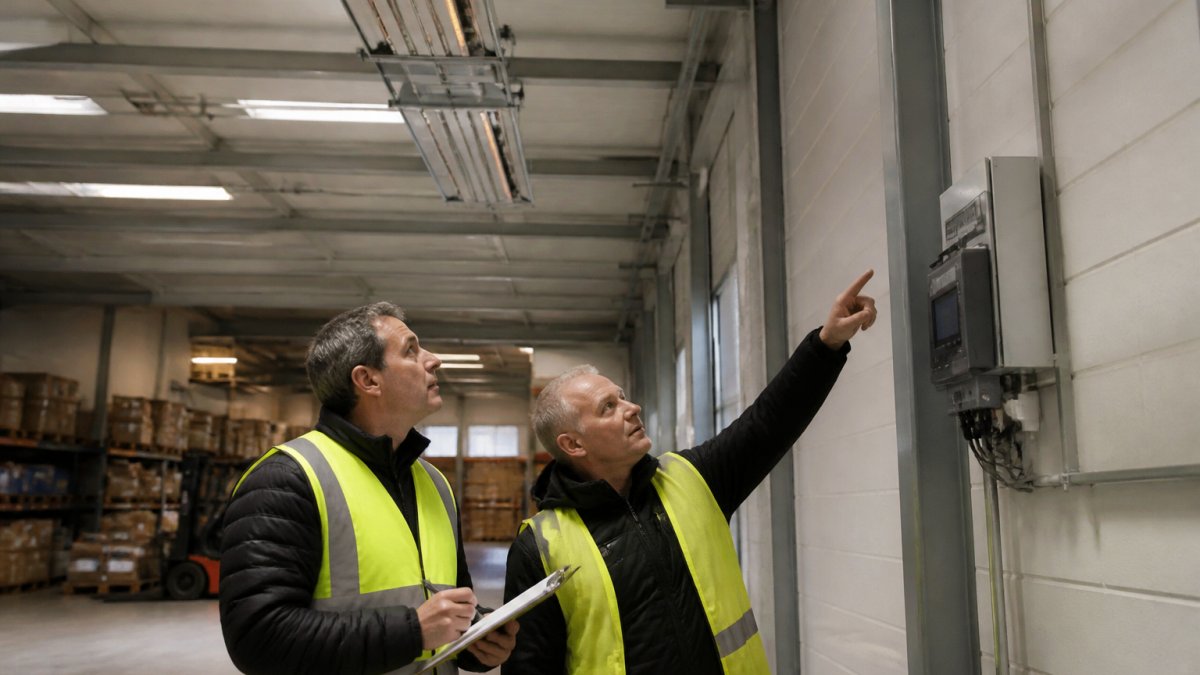
Payback calculation is where most applications succeed or fail, so build it properly. Establish current heating energy consumption and cost, estimate the consumption of the proposed system, and divide the net installation cost by the annual saving.
Work through it in this order:
- Baseline. Gather twelve months of heating fuel or electricity bills for the building. Use actual meter reads, not estimates.
- Heat loss review. Identify where warmth escapes: roof, loading bays, uninsulated doors, and the stratification that pushes heat to roof level.
- Proposed consumption. Ask the manufacturer for an estimated running load based on your floor area, mounting height and occupancy pattern.
- Annual saving. Subtract proposed consumption from baseline, then apply your current unit rate to convert it into a figure in pounds.
- Net cost. Take the installation cost and deduct any confirmed upfront grant or incentive. Only deduct what has been approved in writing.
- Payback. Divide net cost by annual saving.
Where the incentive actually lands
This is the part most guides skip. An upfront capital grant reduces the numerator, the net cost, and shortens payback immediately. A levy relief reduces the running cost of the new system, which improves the annual saving and therefore also shortens payback, but only over time.
Build the calculation so each benefit is applied in the right place. If you stack an upfront grant and a levy relief into a single “total saving” figure, you will overstate the case and an assessor will spot it.
A transparent worked pattern
The figures below are illustrative and use round numbers so the mechanics are visible. Substitute your own meter data and current unit rate.
Line | Illustrative figure |
|---|---|
Baseline annual heating energy cost | £40,000 |
Estimated cost with radiant system | £24,000 |
Annual saving | £16,000 |
Installation cost | £60,000 |
Confirmed upfront grant (illustrative) | £12,000 |
Net cost after grant | £48,000 |
Simple payback (net cost ÷ annual saving) | 3 years |
Now test the sensitivity. If the baseline is overstated because the existing system is already part-efficient, the annual saving shrinks and payback stretches. If the unit rate rises, payback shortens. If the grant is smaller than assumed, the net cost rises. Run the calculation three ways, conservative, central and optimistic, and present the conservative case to the assessor.
The important discipline is honesty about the baseline. If the existing system is already part-efficient, the calculated saving shrinks, and so does the case. That is better discovered before you apply than after.
Applying for Support: Documents, Steps and Verification
Applications succeed on documentation.
Step 1: Confirm the scheme and its current status. Programme rules, deadlines and funding pots change.
Step 3: Obtain itemised quotes. Funding bodies expect a breakdown of equipment, installation and controls.
Step 4: Submit before installation. Most schemes require approval before work begins. Get written confirmation.
Step 5: Install and verify. Keep commissioning records, equipment serial numbers and installer certification. Post-installation verification is standard.
Book a Free Survey Before You Apply
The gap between a good idea and a funded project is usually evidence.
That is the point of a survey. When you are ready to move, you can request your free quotation and start the process with real specification data in hand.
Heating a warehouse efficiently is a solvable problem, but the funding route rewards preparation over enthusiasm.
To discuss your next project Contact Us to get the conversation started.
Flexel: Heating people first since 1978
Frequently Asked Questions
Are there grants for installing radiant heating in a warehouse?
There is no single grant that pays for radiant heating directly. Support usually comes through wider business energy efficiency grants and sector schemes, which fund measures that cut energy consumption. A warehouse heating system upgrade that demonstrably reduces demand can qualify where the scheme lists heating as an eligible measure. Check the current rules of each scheme before committing, because eligibility and funding levels change, and confirm with the administering body whether radiant or infrared systems are accepted.
Do energy-efficiency incentives cover electric radiant heating?
Some do, some do not. Schemes vary in how they define qualifying equipment, and electric heating is treated differently from gas or renewable heat in several programmes. Before you apply, read the eligible measures list and check whether infrared panels or radiant tube heaters appear. Where a scheme is technology-neutral and scores projects on measured energy savings, a well-specified radiant system can compete on its own figures. Keep the manufacturer’s technical documentation ready as evidence.
How can a business check whether a heating incentive is still available?
Start with the administering body’s own website rather than a summary article, since schemes open, close and change criteria between rounds. Look for the current application window, the eligible measures list and any cap on funding. Then confirm directly with the scheme administrator before you sign an installation contract. Keep a dated record of what you were told, as evidence of eligibility at the time of application helps if rules are updated mid-project.
What information is usually needed to apply for a commercial heating grant?
Most applications ask for the property details and floor area, your current heating system and fuel type, recent energy consumption figures, and a specification or quote for the proposed upgrade. You may also need to show expected savings and a payback calculation. Having a survey report from the installer strengthens the case, because it documents the existing heat loss and the basis for the projected reduction in energy consumption.