
Last Updated: October 23, 2026
Quick Summary
Infrared panel heater reviews reveal how these systems perform in real homes, focusing on installation ease, energy efficiency, comfort levels, and whether the technology delivers on its promises. The best reviews explain practical outcomes like heating effectiveness, running costs, and installation complexity rather than just listing features or star ratings.
- Infrared panels heat objects and people directly through radiation, reducing energy waste compared to traditional radiators that heat air above head height
- Installation is straightforward as panels mount to walls or ceilings without major building work, making them ideal for retrofits in listed buildings
- Running costs depend on panel wattage, usage patterns, and local electricity rates, with typical panels using between 400 and 2,000 watts
- Right wattage selection requires considering room size, insulation quality, and ceiling height, roughly 100 watts per square metre for well-insulated rooms
- Quality panels meet international safety standards like EN 60335-2-96, whilst budget alternatives often skip independent verification
Table of Contents
- What Infrared Panel Heater Reviews Tell You
- Infrared Heating Panels Pros and Cons
- Infrared Panel Heater Running Costs Explained
- Infrared Panel Heater Wattage Guide
- Best Infrared Panel Heaters: What Sets Them Apart
- Choosing the Right System for Your Space
- Frequently Asked Questions
What Infrared Panel Heater Reviews Tell You
When you’re researching infrared panel heater reviews, you’re looking for honest insight into how these systems perform in real homes and workplaces. Reviews reveal what matters most: installation ease, energy efficiency, comfort levels, and whether the technology actually delivers on its promises. At Flexel, we’ve spent decades manufacturing infrared heating solutions, and we’ve learned that the best reviews focus on practical outcomes rather than marketing claims.
The truth is, most reviews miss the fundamentals. They focus on features without explaining how those features translate into daily comfort or monthly energy bills. A genuine infrared panel heater review should tell you whether the system heats your space effectively, how much it costs to run, and whether it’s genuinely easier to install than traditional alternatives.
What separates useful reviews from generic ones is specificity. Does the review explain wattage requirements for your room size? Does it address installation complexity? Does it compare running costs to other heating methods? These details matter far more than star ratings.
Infrared Heating Panels Pros and Cons
Key Advantages
Infrared heating panels deliver warmth through direct radiation rather than heating the air around them. This fundamental difference creates several genuine benefits worth understanding.
The most significant advantage is energy efficiency. Because infrared panels warm objects and people directly, they don’t waste energy heating empty space above head height like traditional radiators do. You feel comfortable at lower air temperatures, which reduces overall energy consumption. Many facilities managers find this approach can help reduce heating costs compared to conventional systems, particularly in spaces with high ceilings or poor insulation.
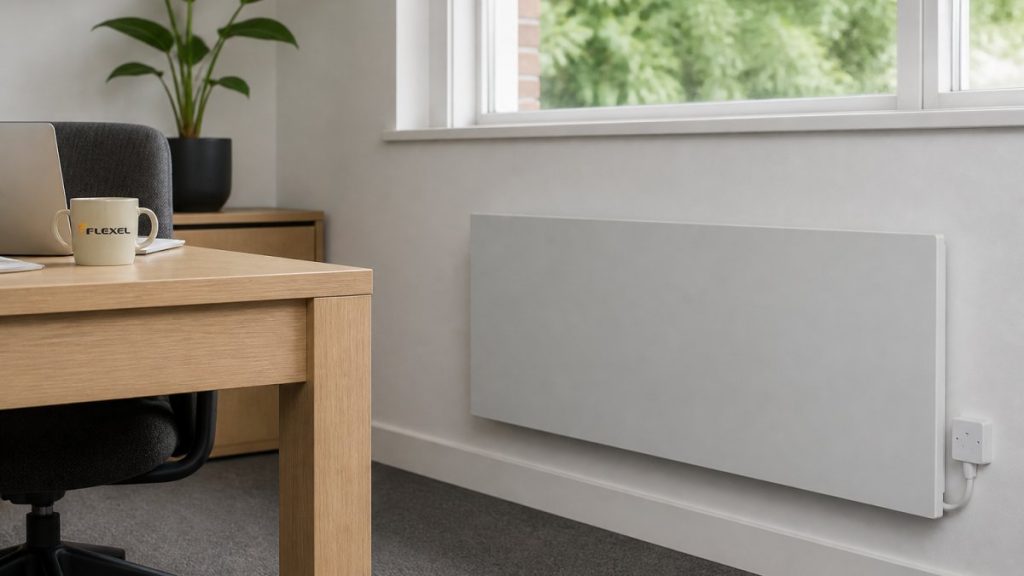
Installation simplicity is another real strength. Unlike underfloor heating systems or central heating pipework, infrared panels mount directly to walls or ceilings. An electrician can install most systems. This makes them ideal for retrofits in listed buildings or properties where disruption needs to stay minimal. Flexel’s panels are designed for straightforward installation without requiring major building work.

Space-saving design matters more than many homeowners realise. Traditional radiators demand wall space, reduce usable floor area, and create visual clutter. Infrared panels are slim, unobtrusive, and can mount almost anywhere. For small properties or contemporary interiors, this flexibility is genuinely valuable.
Comfort characteristics differ meaningfully from conventional heating. Infrared warmth feels more like sunlight than forced air. Your body absorbs the radiant energy directly, which many people find more pleasant. There’s no cold spot near the floor, no hot air rising to waste energy at ceiling level, and no air circulation creating draughts.
Limitations to Consider
Infrared panels aren’t perfect for every situation, and honest reviews acknowledge where they underperform.
Zone control requires careful planning. Each panel typically operates independently, which means you need multiple units and separate thermostats to heat different rooms. For a small flat, this works fine. For a large house with complex usage patterns, managing multiple zones can be more involved.
Initial investment varies significantly based on room size and panel specifications. Energy savings accumulate over time, but the payback period depends entirely on your previous heating method and local energy costs.
Installation still requires an electrician for electrical connections, even though the physical mounting is straightforward. You can’t simply bolt a panel to a wall and plug it in. Proper wiring, circuit protection, and thermostat integration need professional attention.
Thermal mass works against infrared panels in some scenarios. Because they heat spaces quickly without warming walls or furniture significantly, the room cools rapidly when the panels switch off. Traditional radiators continue releasing stored heat for a while after the heating stops. For intermittently-used spaces, this matters less. For continuously-occupied rooms, it’s a minor consideration.
Infrared Panel Heater Running Costs Explained
Understanding running costs requires looking at three factors: panel wattage, usage patterns, and your local electricity rates.
A typical infrared panel uses between 400 and 2,000 watts depending on room size and desired temperature. A 1,000-watt panel running continuously for one hour consumes one kilowatt-hour of electricity. Multiply that by your local unit rate, and you have the hourly cost. Most people don’t run panels continuously, thermostats cycle them on and off based on room temperature.
The real cost depends on your heating behaviour. A bedroom panel heating for six hours daily costs less than a living room panel running twelve hours. A well-insulated room reaches target temperature faster and maintains it with shorter heating cycles, reducing consumption. A poorly insulated space demands constant operation, pushing costs higher.
Comparing infrared panels to other heating methods reveals where the economics shift. Electric storage heaters, portable heaters, and conventional electric radiators all cost roughly the same to run per watt. The difference lies in efficiency, how effectively each system converts electrical energy into usable warmth. Infrared panels excel here because they eliminate wasted heat rising above head height.
Against gas central heating, infrared panels can offer a different approach to heating. Gas central heating requires ongoing maintenance, occasional repairs, and can lose heat through pipework and radiators. Infrared panels have no moving parts, no boiler servicing, and no heat loss in distribution.
The payback calculation shifts when you factor in installation costs, system lifespan, and maintenance. Flexel’s infrared panels are designed for long-term reliability.
Infrared Panel Heater Wattage Guide
Selecting the right wattage is essential for comfort and efficiency. Too little power, and your space never reaches target temperature. Too much, and you’re paying for unnecessary capacity.
The starting point is room size and insulation quality. A rough guide suggests 100 watts per square metre for well-insulated rooms, and 150 watts per square metre for poorly insulated spaces. A 20-square-metre bedroom in a modern flat might need 2,000 watts total. The same room in a Victorian terraced house with single-glazed windows could need 3,000 watts.
Ceiling height affects the calculation. Rooms with high ceilings require more wattage because the volume of air to heat is greater. Kitchens and bathrooms often need higher wattage than bedrooms because moisture and ventilation remove heat continuously.
Usage patterns matter too. A guest bedroom used occasionally can function with lower wattage than a home office occupied eight hours daily. Flexel’s range includes panels from 400 watts to 2,000 watts, allowing precise matching to your specific needs.
The most common mistake is installing panels that are too powerful. Oversized systems cycle on and off frequently, which can lead to temperature swings. Undersized systems run continuously without reaching comfort. Correct sizing balances comfort with efficiency.
Best Infrared Panel Heaters: What Sets Them Apart
Quality infrared panels share several characteristics that distinguish them from budget alternatives.
Manufacturing standards matter significantly. Panels built to international standards like EN 60335-2-96 and IEC 60800 have undergone rigorous safety and performance testing. Flexel’s panels meet these standards, which means they’ve been independently verified for reliability and safety. Budget panels often skip this verification.
Heat distribution consistency is a key factor. A well-engineered panel aims to heat your space evenly without hot spots or cold zones.
Thermostat integration and control options affect daily usability. Panels that work with standard thermostats allow for precise temperature management.
Warranty and support indicate manufacturer confidence. Flexel backs its products with comprehensive warranties and technical support because we stand behind the engineering.
Build quality and material selection influence long-term performance. Premium panels use quality electrical components, durable mounting hardware, and finishes that resist degradation.
Choosing the Right System for Your Space
Selecting an infrared panel system requires honest assessment of your specific situation.
Start by identifying your heating needs. Are you replacing an entire heating system or supplementing existing radiators? Do you need to heat one room or multiple spaces? Is your property well-insulated or draughty? These questions determine whether infrared panels are appropriate and what capacity you need.
Room characteristics influence the decision. Small, well-insulated rooms with regular occupancy are ideal for infrared panels. Large, open-plan spaces with variable usage patterns may require careful consideration of the heating approach. Listed buildings where you can’t modify walls often favour infrared panels because installation is non-invasive.
Installation logistics matter practically. Can an electrician access your circuit board easily? Do you have suitable wall or ceiling space for panel mounting? Will the aesthetic appearance work with your interior design? These practical considerations often determine feasibility.
Budget considerations extend beyond purchase price. Factor in installation costs, running expenses over five or ten years, and maintenance requirements. Compare this total cost to your current heating expenses and alternative systems.
Professional assessment adds confidence to your decision. Flexel offers free quotations where our team evaluates your space, heating requirements, and system options. This removes guesswork and ensures your choice matches your actual needs rather than generic recommendations.
Frequently Asked Questions
Are infrared panel heaters effective for heating a room?
Infrared panel heaters deliver direct radiant warmth that reaches people and objects rather than heating air, which many users find more effective than convection heating. They work well in well-insulated spaces and are particularly effective in rooms with poor air circulation. Their effectiveness depends on panel wattage, room size, and insulation quality. For optimal performance, match the wattage to your space dimensions and ensure windows and doors are properly sealed.
What size infrared panel heater do I need for my room?
A general rule is 10 watts per square foot of floor area in well-insulated rooms, or up to 15 watts per square foot in poorly insulated spaces. Factors like ceiling height, external walls, and climate affect the calculation. Consult a heating engineer or request a free survey to determine your exact infrared panel heater wattage requirements.
Can infrared panel heaters be used as a main heating system?
Yes, infrared panels can serve as a primary heating system in well-insulated homes and commercial buildings, particularly when zoned control allows you to heat occupied spaces selectively.
Are infrared panel heaters expensive to run?
Running costs depend on panel wattage, usage hours, and your electricity tariff. Energy savings can come from zoned heating—you warm only occupied spaces rather than entire buildings. Exact infrared panel heater running costs vary by property and usage patterns, so contact us for a personalised assessment of your potential savings.
Infrared panel heater reviews ultimately reflect one truth: the best system matches your specific space, usage patterns, and comfort priorities. There’s no universal “best” panel, only the right choice for your situation.
To discuss your next project Contact Us to get the conversation started.
Flexel: Heating people first since 1978