
Last Updated: 7 November 2026
Quick Summary
The main heating options for homes without gas are infrared panels, electric underfloor heating and zoned electric heating. Infrared panels suit rooms used in short bursts, underfloor heating suits rooms where comfort matters most, and zoning ties both together so you stop paying to heat empty space.
- Infrared panels reach working temperature in minutes and suit living rooms, studies and hard-to-heat rooms.
- Mount panels where people actually sit, and keep the panel face clear of furniture.
- Electric underfloor heating warms slowly and works best left on a steady schedule.
- Zoned electric heating gives each area its own thermostat and schedule, cutting waste.
- Flexel has made ink-based EcoCloth and EcoFilm elements at its Glenrothes factory since 1978.
Table of Contents
- Heating Options for Homes Without Gas: The Quick Comparison
- Electric Heating for Homes Without Gas: How It Actually Works
- Infrared Heating Panels for Homes: Room-by-Room Warmth
- Electric Underfloor Heating: Comfort Underfoot
- Zoned Electric Heating: Control Each Room Separately
- Pros and Cons of Each Electric Heating Option
- Request a Free Quotation for Your Home
- Frequently Asked Questions
Heating Options for Homes Without Gas: The Quick Comparison
Homes without a gas connection face a narrower set of heating options, and electric systems now cover almost every case. At Flexel, we have manufactured electric radiant heating in our UK factory in Glenrothes since 1978. This guide compares the three main routes: infrared panels, electric underfloor heating and zoned electric heating.
The short answer: infrared panels suit rooms used in short bursts, underfloor heating suits rooms where comfort matters most, and zoning ties both together so you stop paying to heat empty space. Below, we break down how each works, who it fits and what to watch for.
| Option | Best For | Warm-Up Speed | Disruption |
|---|---|---|---|
| Infrared panels | Living rooms, studies, hard-to-heat rooms | Minutes | Minimal |
| Electric underfloor heating | Kitchens, bathrooms, hallways | Slow, steady | Higher at installation |
| Zoned electric heating | Whole homes, varied occupancy | Depends on system | Moderate |
Electric Heating for Homes Without Gas: How It Actually Works
Electric heating for homes without gas converts electricity directly into heat at the point of use. There are no pipes, no boiler and no flue, which removes the maintenance that comes with a wet system.
Radiant systems work differently from convection radiators. Instead of warming the air, they emit infrared energy that warms people and surfaces directly. Flexel’s EcoCloth elements, made at our factory in Glenrothes, are ink-based and form the core of our far infrared panels; our EcoFilm element is also made at our Glenrothes factory.
Infrared Heating Panels for Homes: Room-by-Room Warmth
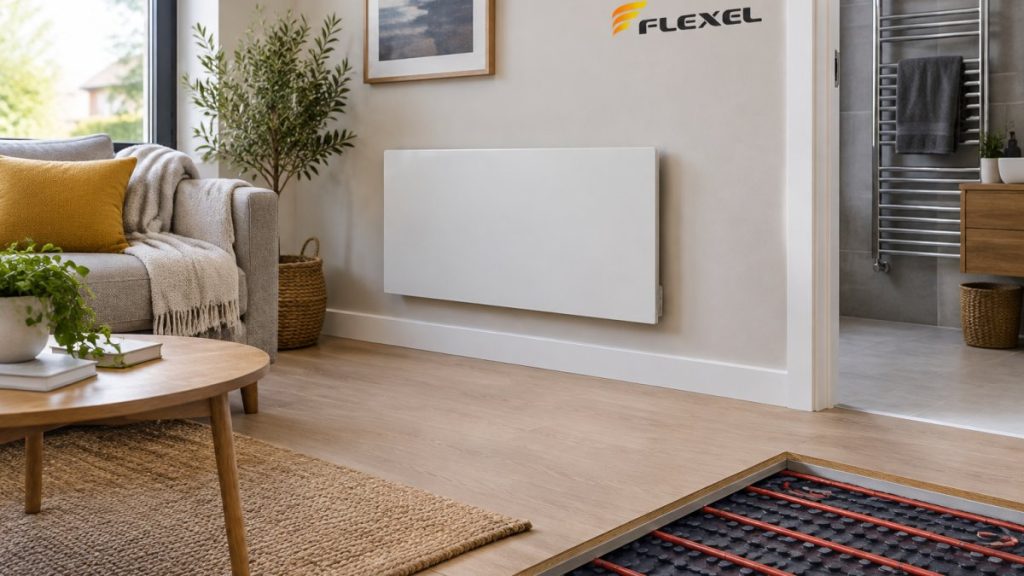
Infrared heating panels are slim, wall-mounted emitters that warm objects and people rather than the surrounding air. They reach working temperature quickly, so they suit rooms used in short bursts: a study in the morning, a living room in the evening.

What most guides miss is placement. A panel mounted high on a wall pushes warmth over head height; mount it where people actually sit. Before choosing panels, it helps to read guidance on what to look for in infrared panel reviews so you can judge build quality and element type rather than marketing claims.
Watch out: panels hidden behind furniture waste most of their output. Keep the face of the panel clear.
Electric Underfloor Heating: Comfort Underfoot
Electric underfloor heating is a mat or cable system laid beneath the floor finish that turns the whole floor surface into a low-temperature radiator. It gives the most even comfort of any electric option, with no wall space used at all.
Installation is the deciding factor. A step-by-step installation walkthrough will tell you quickly whether your floor build-up and subfloor suit it. For running costs, floor coverings and thermostat choice, our electric underfloor heating FAQs answer the questions that come up most often before a renovation.
The trade-off is speed. Underfloor systems warm slowly and work best left on a steady schedule rather than switched on demand.
Zoned Electric Heating: Control Each Room Separately
Zoned electric heating divides a property into separately controlled areas, each with its own thermostat and schedule. It stops you heating rooms nobody is using.
For a house with a home office, spare bedroom and open-plan kitchen, zoning means three different schedules rather than one. Our guide to zoning electric heating walks through the planning step by step, including how to group rooms sensibly.
Pros and Cons of Each Electric Heating Option
Each option has a clear best case, and choosing badly is usually a matter of fitting the system to the wrong room.
Infrared panels
- Pros: fast warm-up, no pipework, minimal disruption, space-saving
- Cons: directional, so placement matters; less suited to rooms occupied all day
Electric underfloor heating
- Pros: even comfort, invisible, frees wall space
- Cons: slow response, higher installation disruption
Zoned electric heating
- Pros: cuts waste, matches heating to occupancy, works with both systems above
- Cons: needs planning and a thermostat per zone
For a domestic infrared panel you can specify today, the EcoSun U+ coloured heating panel shows how a discreet panel fits a normal room.
Best for: homeowners who want room-by-room control without pipework.
Skip if: you need heat in a room within seconds and have no wall space at all.
Request a Free Quotation for Your Home
Working out the right mix of panels, underfloor mats and zoning is where most projects stall. Send us your room schedule and we will tell you which combination fits, with no obligation.
Flexel has been manufacturing ink-based EcoCloth and EcoFilm elements at its UK factory in Glenrothes since 1978, and its systems are approved to international standards including EN 60335-2-96 and IEC 60800. Flexel can advise on your property during a free quotation. Get started with Flexel and specify a system matched to how you actually use each room.
To discuss your next project Contact Us to get the conversation started.
Flexel: Heating people first since 1978
Frequently Asked Questions
Can electric heating keep a home warm without a gas connection?
Yes. Electric heating systems such as infrared panels and underfloor heating can warm a whole home without gas. Infrared panels heat people and objects directly rather than the air, so rooms feel warm quickly. Underfloor heating provides steady background warmth. Both work well in well-insulated properties, and pairing them with zoned controls keeps running costs in check.
Are infrared heating panels suitable for heating a whole home?
Infrared heating panels for homes work well as a whole-house solution when sized correctly for each room. They are slim, wall-mounted and heat directly, so corridors and rarely used rooms warm up fast. Flexel’s infrared panels use ink-based EcoCloth elements made at its UK factory in Glenrothes since 1978. For larger open spaces, combine panels with underfloor heating for consistent comfort.
Is electric underfloor heating suitable for homes without gas?
Electric underfloor heating suits homes without gas, especially during renovations when floors are being lifted. It provides even warmth and frees up wall space. A free quotation from Flexel helps confirm suitability for your floor build-up.
Can electric heating be controlled room by room?
Yes. Zoned electric heating lets you set different temperatures in each room, so you only heat the spaces you use. This suits home offices, spare bedrooms and open-plan living areas with different usage patterns. Thermostats and timers per zone reduce waste. Flexel can discuss your layout during a free quotation.