
Last Updated: November 16, 2026
Quick Summary
Infrared heating products for churches are worth it because they warm people and surfaces directly rather than the air, so warmth lands on the congregation instead of rising to the roof and escaping. They suit tall naves, historic interiors and intermittently used buildings, provided the system is correctly sized, mounted and zoned.
- Radiant heat travels in a straight line from heater to people and surfaces in its path.
- A 600 × 600 mm EcoSun panel is rated at 300 W, against around 450 W for a typical cable-element panel.
- Use EcoSun S+ as main heaters for naves, chancels and other high-ceiling areas, in white or black.
- Zone the nave, side chapel, hall and vestry separately, with frost protection only for porch and vestry.
- Check consent with the Diocesan Advisory Committee or conservation officer before ordering equipment.
Table of Contents
- Why Infrared Heating Suits Church Buildings
- Infrared Heaters for High Ceilings in Naves and Chancel
- Church Pew Heating and Targeted Warmth for Congregations
- Church Heating Controls and Zoned Warmth
- Infrared Heating for Listed Buildings and Heritage Sites
- Book a Free Survey for Your Church Heating Plan
- Frequently Asked Questions
Why Infrared Heating Suits Church Buildings
Infrared heating panels for churches work because they warm people and surfaces directly rather than the air. At Flexel, we have manufactured ink-based EcoCloth far infrared elements at our Glenrothes factory since 1978.
A church is hard to heat well. Naves are tall, fabric is often leaky, doors open all morning, and the building sits empty most of the week. Convection heating warms air that rises to the roof and escapes. Radiant heat travels in a straight line from panel to the people and surfaces in its path, so warmth lands on the congregation rather than the ceiling.
That distinction is the basis for the benefits that radiant heating offers:
- Targeted warmth where people sit
- No visible glow from our panels
The trade-off is that radiant heating still needs correct sizing, mounting height and positioning. Wattage alone tells you little: ceiling height, insulation, draughts, glazing, occupancy and where people sit all change the answer. Specifying from floor area or wattage alone is a common mistake in electric heating, and a panel at the wrong height will disappoint regardless of its rating.
Infrared Heaters for High Ceilings in Naves and Chancel
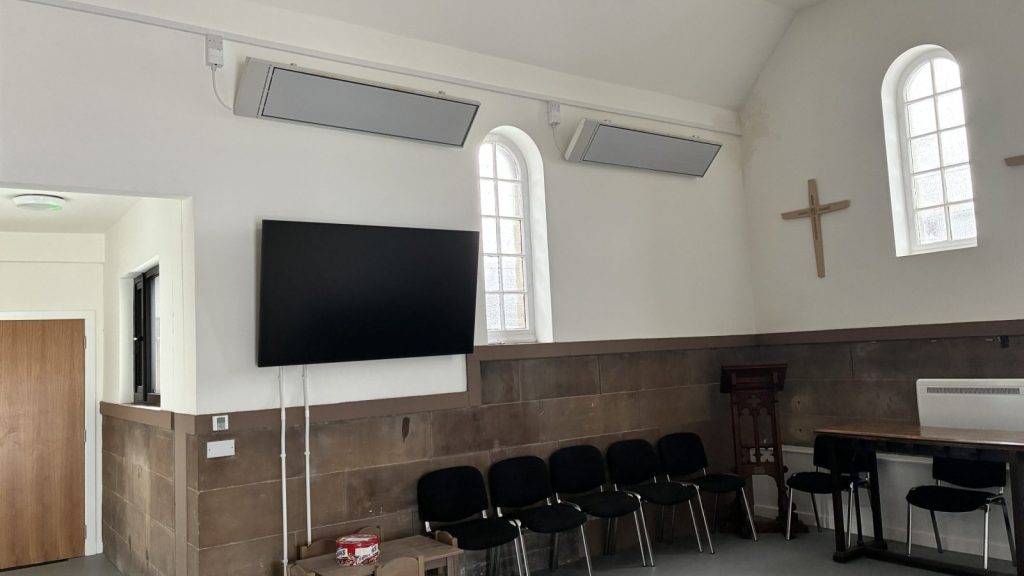
For naves, chancels and other high-ceiling areas, the right approach is a main heater mounted overhead and aimed at the occupied zone. Our EcoSun S+ is built for this and comes in white and black to blend in with the environment.

High-ceiling spaces reward different logic from domestic rooms. You are not raising air temperature across the whole volume; you are putting radiant energy on the people in the pews. Mounting height, panel angle and distance to the nearest occupied row matter more than raw wattage.
A 600 × 600 mm EcoSun panel is rated at 300 W, compared with around 450 W for a typical cable-element panel of that size. Actual performance depends on the building, controls, installation and how the heating is used.
You can see the full range of church infrared heating systems.
Church Pew Heating and Targeted Warmth for Congregations
Church pew heating flips the problem around: instead of heating a whole nave, you warm the people in the seats.
Where it works best:
- Historic interiors where overhead fixing points are limited
- Churches with fixed pews and predictable seating
- Side chapels and small halls with low ceilings
- Supplementary warmth alongside a main nave system
Targeted pew heating is for seated comfort rather than whole-building heating, so treat it as targeted comfort rather than a substitute for a whole-building plan.
Church Heating Controls and Zoned Warmth
Zoned control turns a good heater into a sensible running cost. A church often has several areas with different occupancy, such as nave, chancel, side chapel, hall, vestry and porch. Heating them all at once wastes energy on empty rooms.
Our FlexelTouch WiFi thermostat keeps the proven features of the original FlexelTouch with an updated touch screen and Wi-Fi connectivity, so different zones can be managed separately and adjusted remotely. Pair it with occupancy sensors and thermostatic control, and the building only heats the areas in use.
A practical zoning plan
Zone | Typical use | Control approach |
|---|---|---|
Nave and chancel | Sunday services, events | EcoSun S+ main heaters on timed schedule |
Side chapel | Midweek services | Local thermostat, short pre-heat |
Church hall | Lettings, community use | Independent timer per booking |
Vestry and porch | Preparation, entry | Frost protection only |
Scheduling around service times
Matching pre-heat to actual use, rather than running a fixed schedule whether or not anyone is present, is a sensible approach for an intermittently used building.
A workable approach:
- Weekly template, set the regular services, midweek events and hall lettings as recurring schedules.
- Exception days, weddings, funerals and festivals override the template for that day only, without disturbing the rest of the week.
- Remote adjustment, WiFi control lets the schedule be changed when a service time moves, without a site visit.
- Frost protection, vestry, porch and any plant areas held at a low background setting through the winter.
Occupancy sensing and building management
Occupancy sensors can be used alongside zoned controls. Where a church has a building management system, controls can be integrated so heating, lighting and access sit on one schedule. Confirm the thermostats, receivers and any BMS interface speak the same protocol before specifying, and agree who will commission the integration.
Confirm the controls are compatible with the heaters and that they offer the functions you need before you commit.
Infrared Heating for Listed Buildings and Heritage Sites
Listed buildings change the calculation. You cannot run pipework through medieval fabric, radiators clutter walls never designed for them, and fixings may need consent. Infrared panels can suit heritage sites because they are surface-mounted and can be positioned to keep the radiant path clear of important features. At Flexel, our ink-based EcoCloth far infrared elements have been manufactured at our Glenrothes factory since 1978.
Consent: faculty jurisdiction and listed building consent
Consent requirements for church works depend on denomination, listing grade and scope. Check with the relevant consenting body, such as the Diocesan Advisory Committee or conservation officer, before ordering equipment.
Protecting historic fabric
Position panels so the radiant path lands on the occupied zone, pews, aisles, seating, rather than decorative fabric, and keep sensible clearance from anything painted, gilded or fragile.
Fixings and reversibility
Reversible, surface-mounted installations are generally easier to justify in historic settings than anything cutting into historic fabric. Agree fixing points with the DAC or conservation officer as part of the specification, and record the installation so future removal is straightforward.
For a deeper look at the constraints and approvals involved, read our guide to infrared panels for listed buildings.
Book a Free Survey for Your Church Heating Plan
A heating plan works best when it is based on the actual building. Ceiling height, insulation, draughts, glazing, occupancy and mounting heights are all things a survey can measure.
We offer a free quotation following a site survey or remote survey, so the system is sized to your building and how it is actually used. A qualified electrician should check circuit capacity and any contactors or switching equipment needed. Ask what assumptions sit behind any energy-saving estimate, as results depend on the building, tariff, controls and how the heating is used.
To discuss your next project Contact Us to get the conversation started.
Flexel: Heating people first since 1978
Frequently Asked Questions
Are infrared panels suitable for churches?
Yes, infrared panels work well in churches because they warm people and surfaces directly rather than heating the whole air volume. This matters in high-ceiling spaces where convection heating rises and escapes. Flexel’s EcoSun S+ heaters are designed as main heaters for naves, chancels and other high-ceiling areas, and are available in white or black to blend with the interior. A free survey helps confirm the right output and positioning for your building.
What type of heating is best for a church with high ceilings?
Radiant infrared heating can suit high-ceiling churches. It sends warmth to people and objects in its path rather than mainly warming the air. EcoSun S+ panels are designed as main heaters for the nave and chancel. Correct sizing, mounting height and controls all affect how well the system performs, so a site survey is worth arranging before committing.
Can infrared heaters warm church pews directly?
Yes. Far infrared heating can provide targeted warmth for seated worshippers rather than heating the whole building, which can be useful when only part of a church is occupied. Output and positioning should be checked against your pew layout and occupancy pattern during a survey.
Are infrared panels suitable for listed or historic churches?
Infrared panels can suit listed buildings because they can be surface-mounted. Flexel’s EcoSun S+ comes in white and black to blend in with the environment. Any installation in a listed building should be checked against the relevant consent requirements and building fabric considerations before work begins, and a qualified electrician should confirm circuit capacity.
How do you control infrared heating in different areas of a church?
Zoned church heating controls let you warm only the areas in use, such as the nave for a service or a side chapel for a smaller gathering. Flexel advises confirming that the thermostat, receiver and heaters are compatible and that the controls provide the functions you need before installation.